Quick answer: The Klipsch Heresy is a compact three-way speaker with a 12-inch woofer and horn-loaded midrange and tweeter, first introduced in 1957 and still made today. When you buy a used pair, check the back labels for matching serials, listen to each speaker for all three drivers, and ask whether the crossovers and drivers are original.
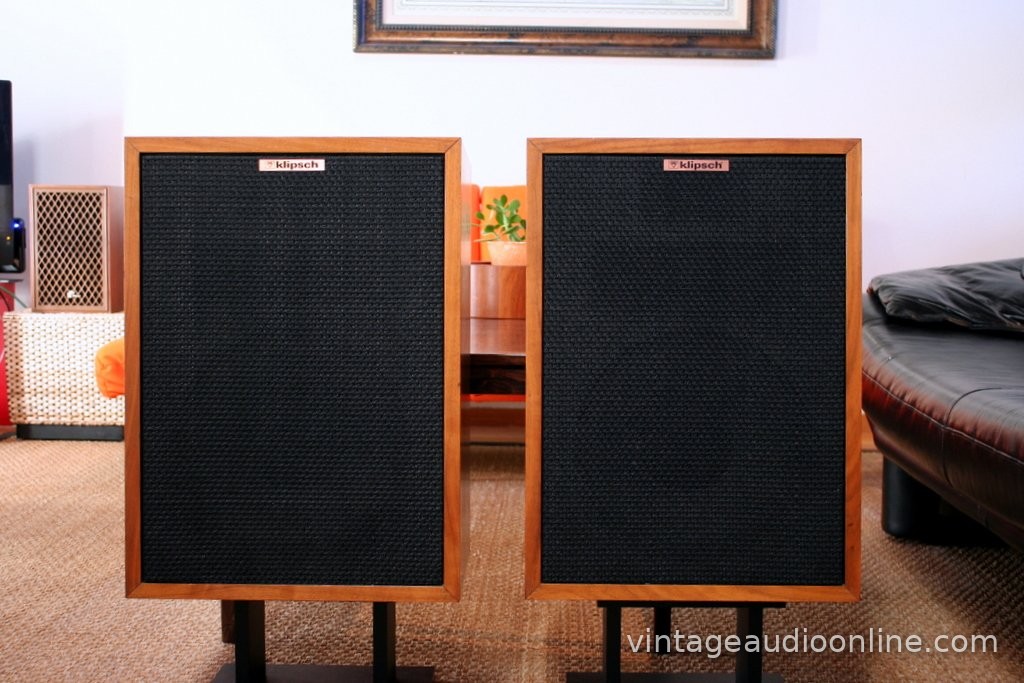
The Heresy is the smallest of Paul Klipsch's Heritage designs, and it still plays big, which is why used pairs are so sought after. The pair in these photos is a Heresy II with its original drivers and networks, and it shows what to look for.
What is the Klipsch Heresy?
Paul W. Klipsch introduced the Heresy in 1957 as a center-channel speaker for three-channel stereo, and Klipsch calls it effectively the world's first commercial center-channel speaker. The name came from a remark that a non-corner Klipsch speaker would be heresy, and Klipsch kept it. A year later, the Heresy was demonstrated at the World's Fair in Brussels.
It's still built by Klipsch in Hope, Arkansas, now in its fourth version, the Heresy IV.
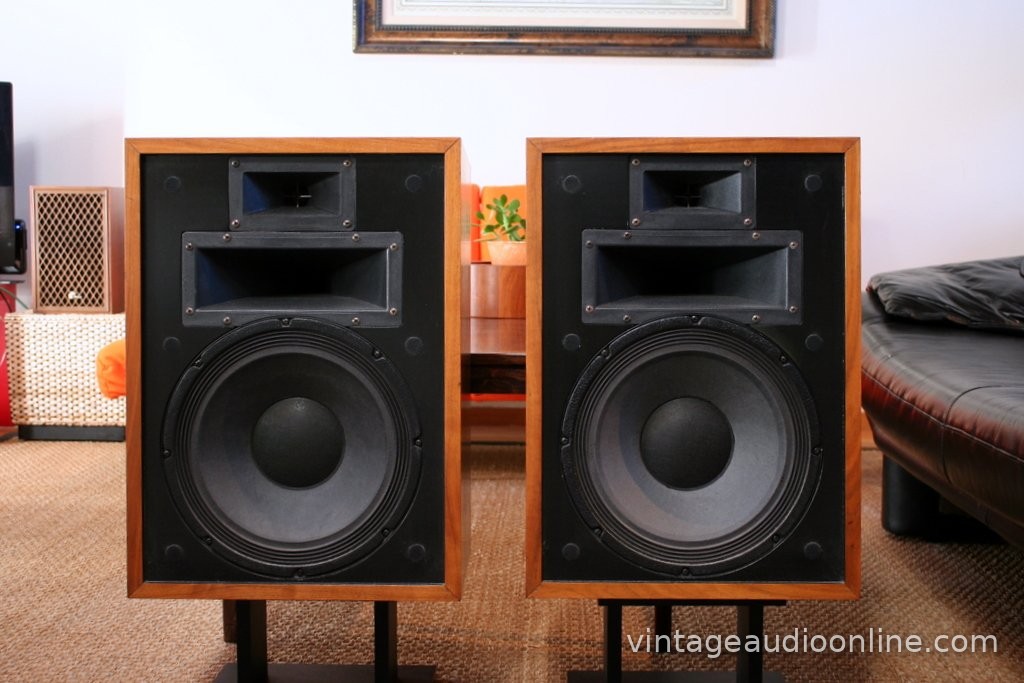
Every Heresy is a three-way design: a 12-inch woofer handles the bass, and two horns handle the midrange and treble. Horn loading is what makes it so efficient. A small amplifier can play it loud.
How can you tell a Heresy I, II and III apart?
The short version:
- Early Heresy (from 1957). The early units differ from later ones in their drivers and are rare.
- Heresy (the "Heresy I"). The long-running original version, with the drivers mounted behind the front board and firing through openings in it.
- Heresy II (from 1985). New midrange and tweeter drivers, and all the drivers moved to the front of the baffle.
- Heresy III (mid-2000s). Titanium-diaphragm midrange and tweeter compression drivers, and bi-wire terminals.
Take the grilles off and the Heresy II is easy to spot: the horns and woofer are bolted to the front of the baffle, not hidden behind it.
What does the back label tell you?
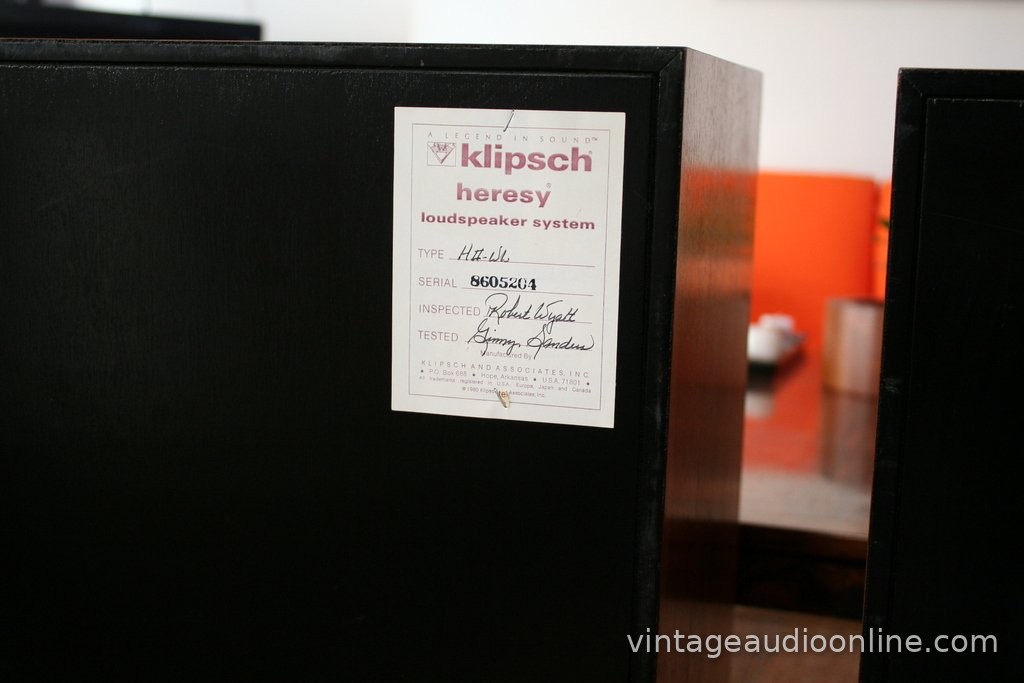
Turn the speaker around before anything else. The Klipsch label lists the model, a type code and a serial number, and many are signed by the people who inspected and tested the speaker. Things to check:
- The two serials are close together. A true pair was usually built together. Serials far apart aren't a deal breaker, but they suggest a mixed pair.
- The label is intact and legible. A missing label makes the version harder to prove. Ask the seller for a clear photo if the listing doesn't show both.
- The two labels match. Same model and type on both speakers.
What should you check on the drivers?
Play each speaker on its own at low volume, with music that has voices and cymbals, and put your ear close to each driver in turn.
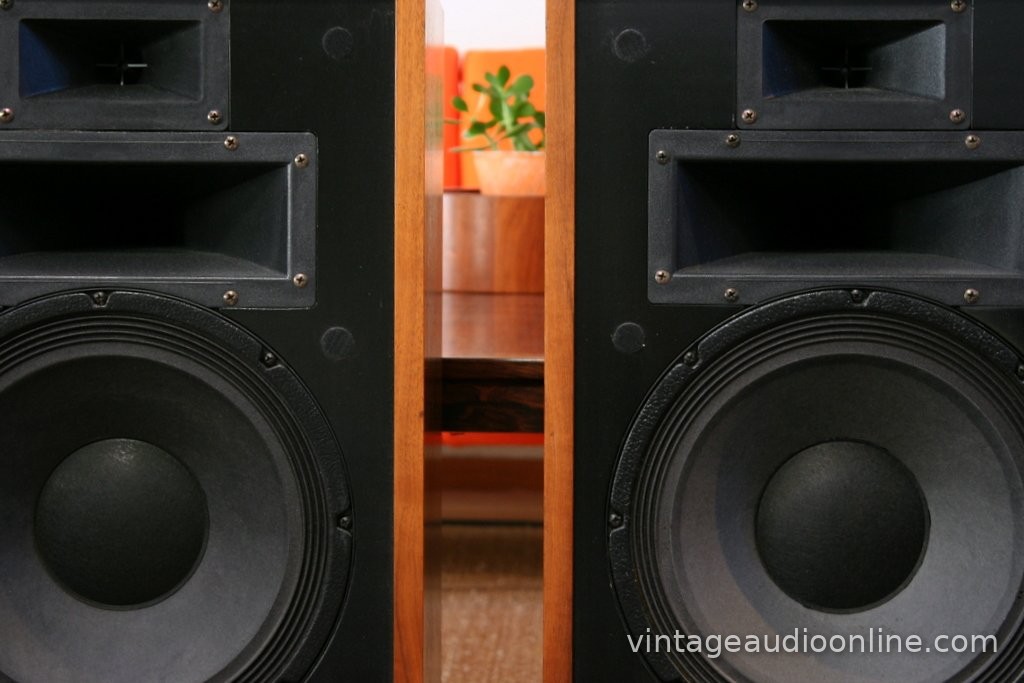
- Woofer. Look at the surround and cone for tears and dents. Press the cone in gently with flat fingers. It should move smoothly with no scraping.
- Midrange horn. Voices should come clearly from the middle horn. A silent or buzzing midrange usually means the compression driver or its diaphragm needs attention.
- Tweeter. Cymbals and "s" sounds should come from the small top horn. If one speaker sounds duller than the other, the tweeter is the first suspect.
- Original parts. Klipsch drivers are usually marked with a part number. Compare both speakers: the same driver in the same position on each is a good sign. Replacement drivers aren't bad in themselves, but they change what you're buying. Ask what was replaced and why.
Has the crossover been touched?
The crossover, or "network," splits the signal among the three drivers. Klipsch revised the Heresy network more than once over the years, and on an older pair its capacitors are decades old. Ask whether the networks are original, rebuilt with new parts, or replaced with an aftermarket design. Any of those can be fine. You just want to know which one you're buying, and the two speakers should match.
What about the cabinet and finish?
Heresys were offered in many finishes over the years, so don't expect two pairs to look alike. Check for:
- Veneer lifting at corners and edges, and water marks on the bottom.
- Grilles that fit snugly and match each other.
- The riser. Many Heresys sit on a small tilted riser that aims the horns up toward your ears when the speaker is on the floor. If it's missing, plan on a stand or riser.
What should you power a Heresy with?
Because they're so efficient, Heresys work well with low-power amplifiers, including small tube amps and modest 70s receivers. Klipsch rates the Heresy III at 99 dB sensitivity, and the earlier versions are also very efficient. The flip side is that horns don't hide much. Hiss and hum from a noisy amp come through clearly, so use a quiet amp and keep the volume sensible on old drivers.
FAQ
Are Klipsch Heresy speakers good for a small room? Yes. They're compact by Klipsch standards and play loud with little power. Aim them at your listening seat.
Is the Heresy II better than the Heresy I? It's different. The II changed the midrange and tweeter drivers and moved them to the front of the baffle. Condition and a well-matched pair matter more than the version.
Do I need a big amplifier? No. A few clean watts per channel can go a long way with a Heresy.
Can I use Heresys as center speakers? The Heresy started life as a center speaker, so it works well that way next to other Klipsch Heritage speakers.
Setup notes
As an Amazon Associate I earn from qualifying purchases.
I've used each of these types of accessory. The links go to Amazon searches, so you can pick the specific product.
- Tilted speaker risers or low stands: if your pair came without its risers, a tilted riser points the horns toward your ears instead of your knees. Make sure it's rated for a heavy speaker.
- 14-gauge speaker wire: plenty for most room-length runs, and easy to fit into older spring clips or screw terminals.
- Banana plugs: neater and more secure than bare wire on binding posts, if your speakers and amp accept them.
Shopping for a Heresy pair?
Ask for a clear photo of both back labels, a photo with the grilles off, and a note on whether all six drivers play. Heresys are heavy, so think about shipping and packing before you buy from far away. These links open eBay search results, not specific listings:
Paid links
- Search eBay for Klipsch Heresy speakers
- Search eBay for Klipsch Heresy II speakers
- Search eBay for Klipsch Heresy III speakers
If you're checking whether a network is stock, original Klipsch literature and a crossover diagram for your exact version are worth tracking down first.