Quick answer: Disconnect the speaker from the amp and any crossover, set a digital multimeter to its lowest ohms range, and put the probes on the driver's two terminals. A healthy driver reads below its rated impedance: roughly 5.5 to 7 ohms for an 8-ohm driver, about 3 for a 4-ohm driver. "OL" means the circuit is open. A reading near zero, or a big mismatch between two drivers of a pair, means look closer.
I run a vintage audio business, so a lot of speakers and loose drivers pass across my bench. A quick meter check is the fastest way to sort the ones worth a listen from the ones headed for repair. The photos in this guide come from one of those sessions: a Fluke meter, a pair of clip leads and a table full of drivers.
What does a multimeter actually measure on a speaker?
It measures DC resistance, the plain resistance of the wire wound on the voice coil. Speaker people call it Re or DCR.
The number printed on the speaker, 4, 8 or 16 ohms, is something else: rated (nominal) impedance. Impedance is how hard the speaker resists an AC music signal, and it changes with frequency. Under the IEC 60268-5 standard, the impedance within the speaker's rated frequency range shouldn't dip below 80% of the rated figure. At DC the reading is usually lower than that, which is why the standard asks makers to state it when it is.
That's why a perfectly good 8-ohm speaker reads 6-something on a meter. Nothing is wrong. A meter only sees resistance at 0 Hz.
How do you test a speaker with a multimeter, step by step?
- Power down. Turn the amplifier off and unhook the speaker wires. Never measure a speaker connected to a powered amp.
- Isolate the driver. Unclip or unsolder one lead from the crossover, or pull the driver. At the cabinet's input terminals you're reading the crossover too, and a tweeter behind a capacitor will read as open even when it's fine, because a capacitor blocks DC.
- Pick the lowest resistance range. On an autoranging meter, just select ohms.
- Zero your leads. Touch the probes together, note the reading (usually a few tenths of an ohm) and subtract it from what you measure.
- Connect to the terminals. Alligator clips keep the contact steady and your hands free. Polarity doesn't matter for resistance.
- Read and compare. Write the number down and measure the matching driver from the other speaker the same way.
A faint click or a tiny cone twitch when the probes touch is normal. The meter sends a small current through the coil.
What should a 4, 8 or 16 ohm speaker read?
As a rough guide:
| Rated impedance | Typical meter reading | Look closer if you see |
|---|---|---|
| 4 ohms | about 3 ohms | open, near zero, or far off its twin |
| 8 ohms | about 5.5 to 7 ohms | open, near zero, or far off its twin |
| 16 ohms | about 11 to 13 ohms | open, near zero, or far off its twin |
The best reference is the maker's own DC resistance figure, if you can find it in a spec sheet or service literature. The second best is the driver's twin. Two drivers of the same model and age should read close to each other on the same meter.
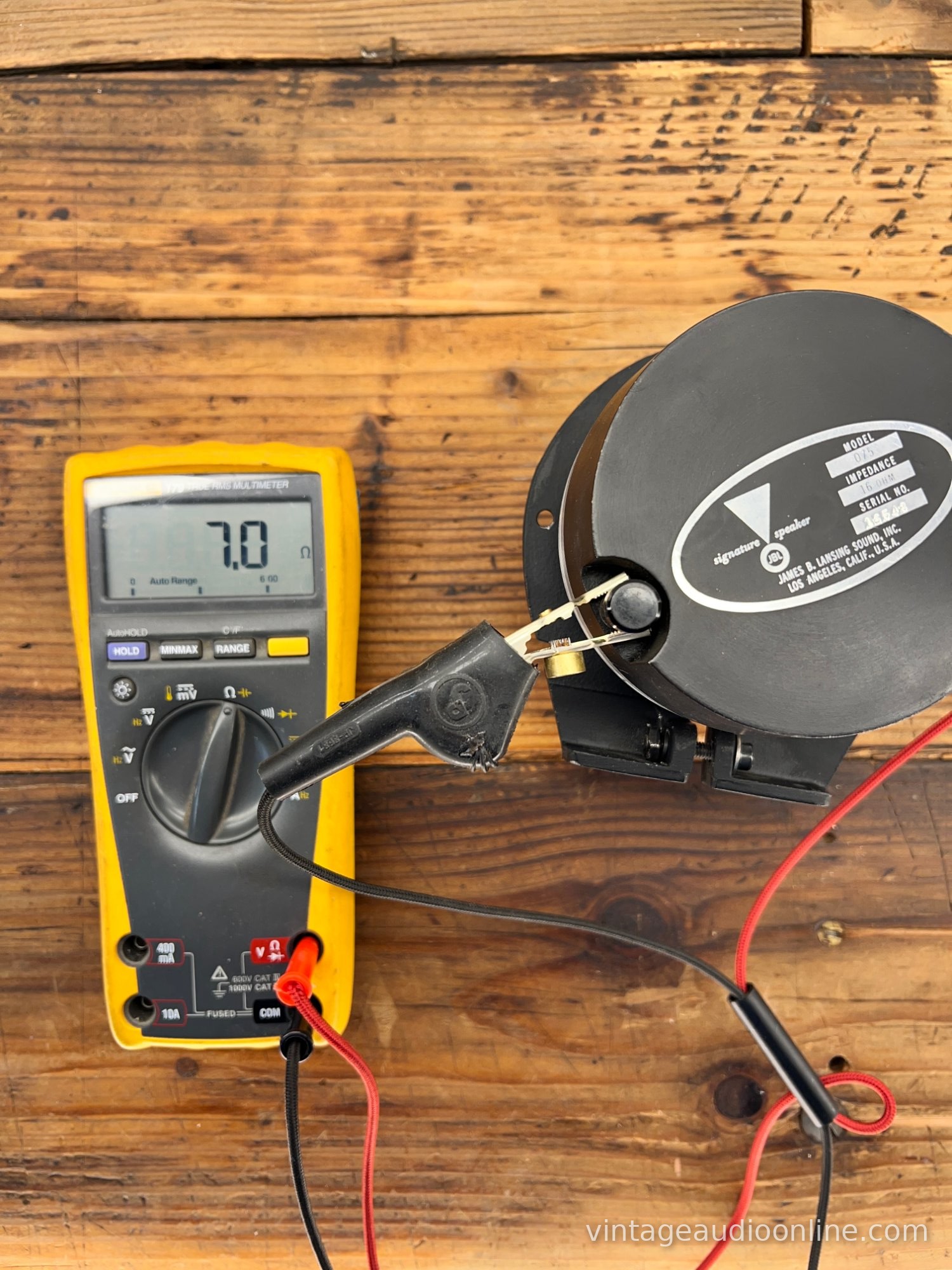
Here's where the photos get interesting. The two JBL 075 tweeters are the same model and both are labeled 16 ohms, but one reads 10.0 and the other 6.9. Both are under 16, as expected, but a gap of about three ohms between twins deserves a listening test and a closer look before you trust the pair.
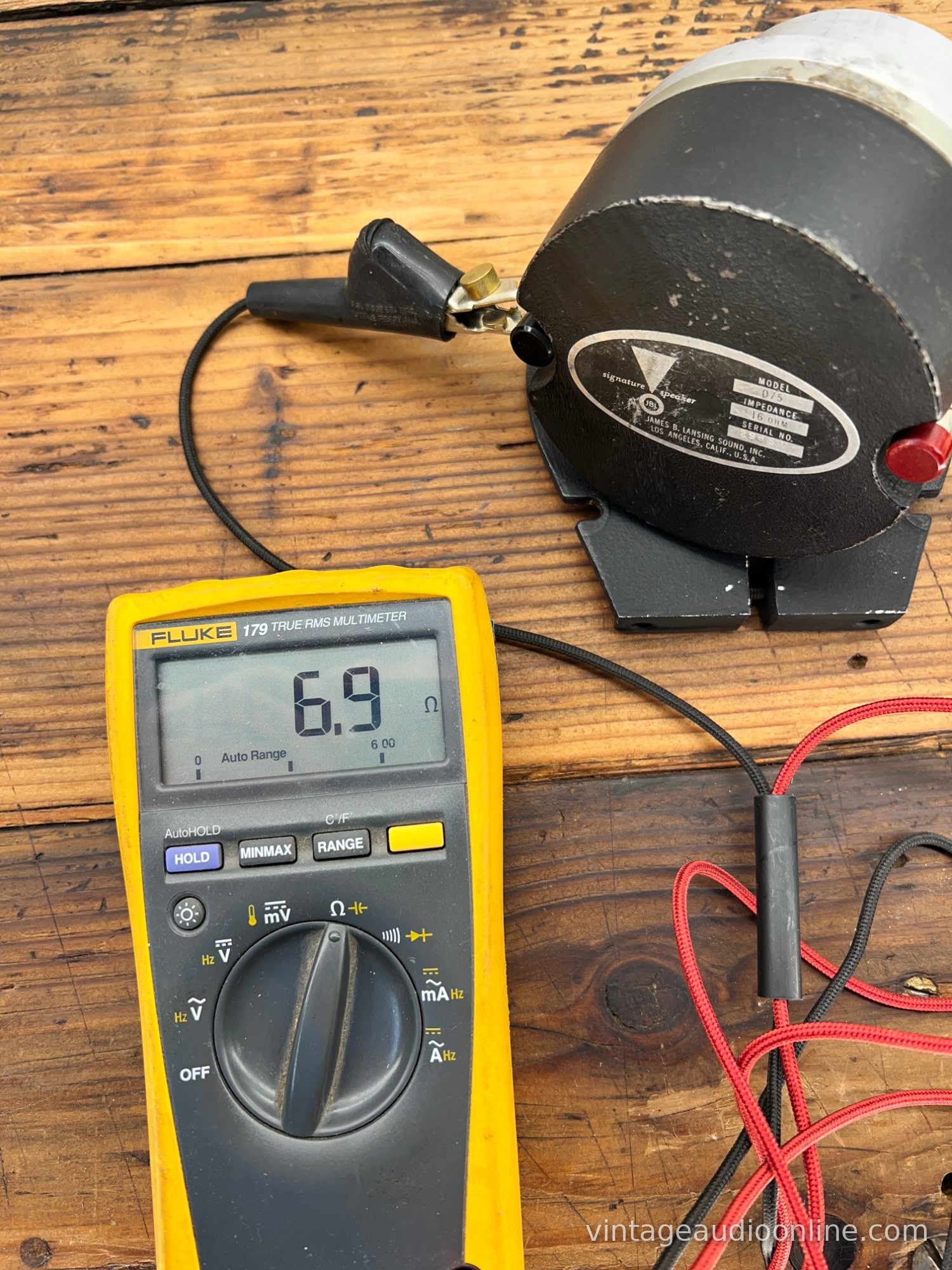
Other drivers from the same session show why a single number means little on its own:
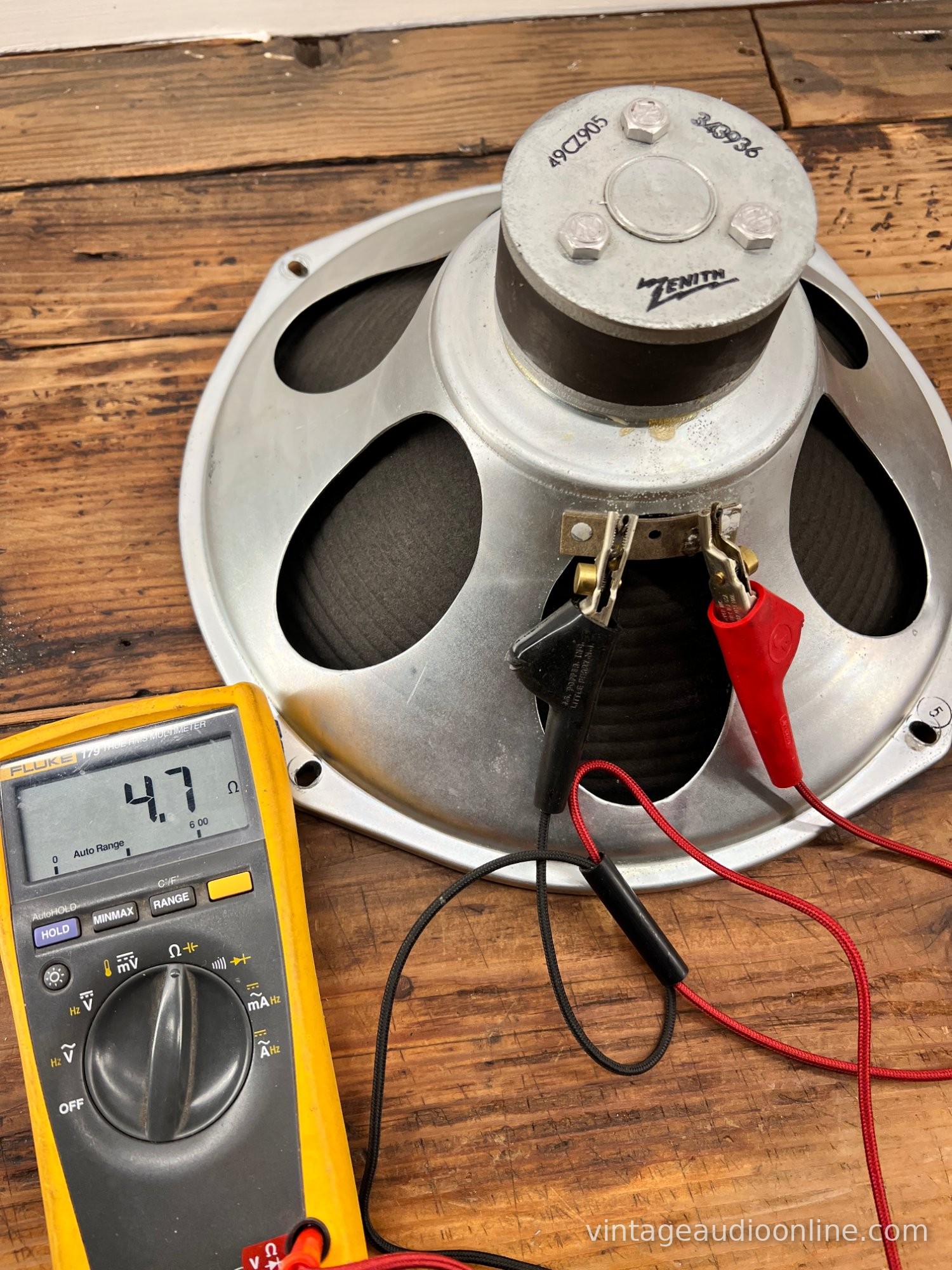
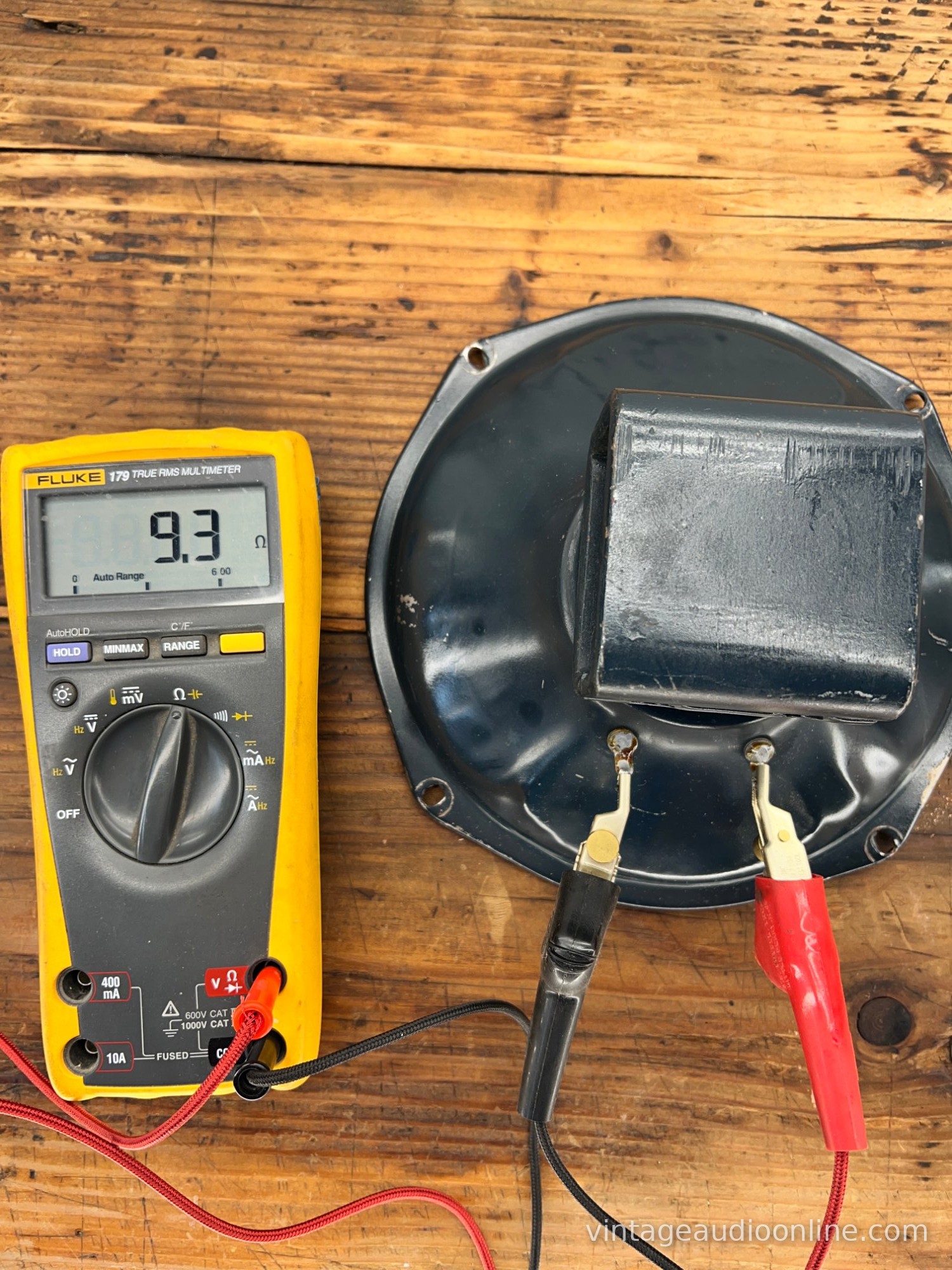
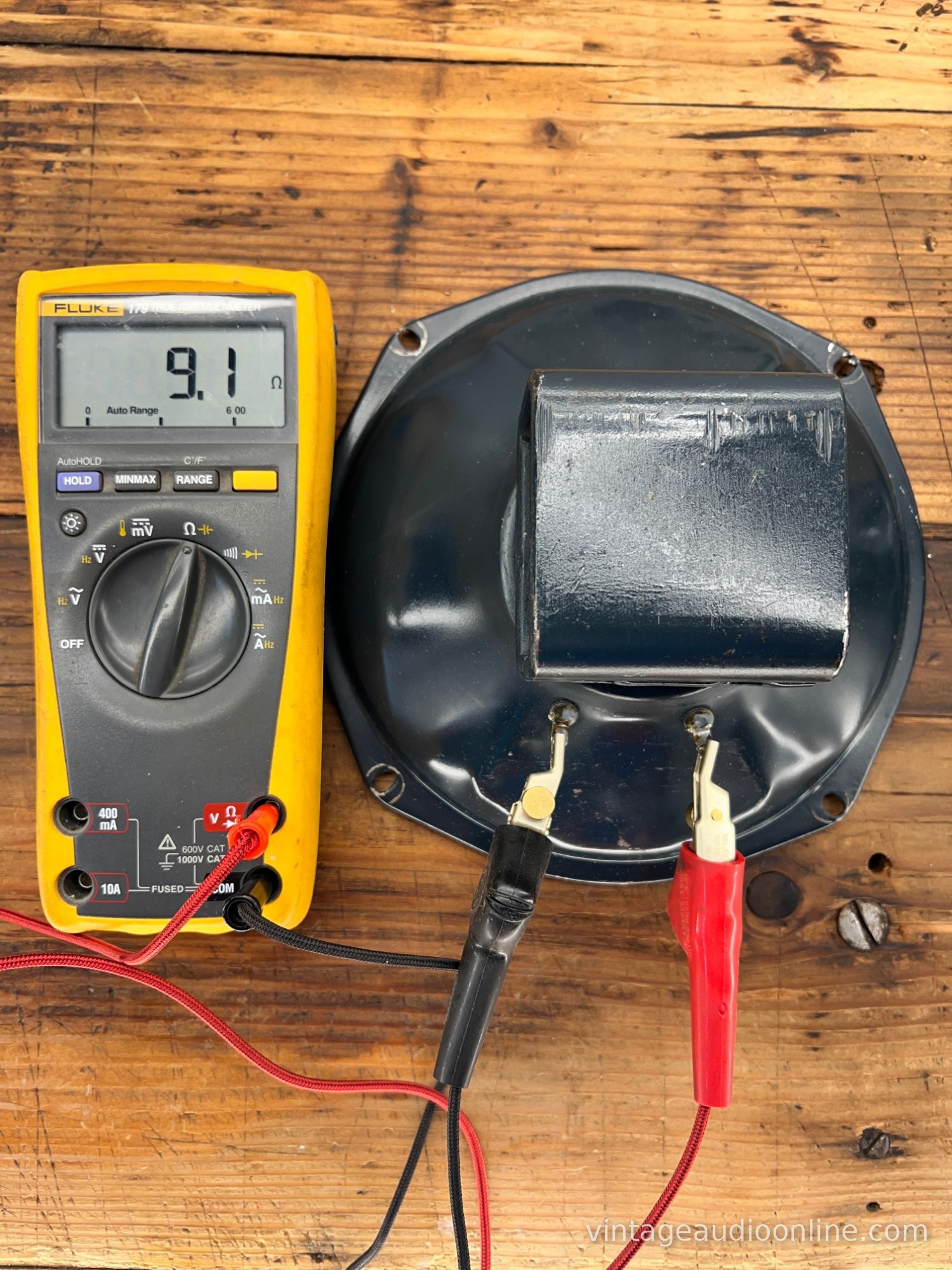
The 9.3 and 9.1 readings on that pair are a good example of a healthy match. What they should read in absolute terms depends on their rating, so check the label or the set they came out of before you compare them with the table.
What readings mean a speaker is bad?
- OL, a "1" at the left of the display, or infinity. The circuit is open: a burnt-through coil, a snapped lead or a broken tinsel lead (the braided wire from the terminal to the cone). Check the terminals and solder joints before you write the driver off.
- Near zero, or far below normal. Turns of the coil may be shorted after overheating. A partly shorted coil can still play, but weak and distorted.
- A number that jumps around while you flex the leads or gently press the cone. That points to a cracked tinsel lead or a bad joint.
- A big mismatch between two drivers of a pair, like the JBLs above. One may have been replaced, rewound or damaged.
Can a speaker pass the meter test and still be bad?
Yes, and often. The meter only proves the coil conducts. A driver can read perfectly and still have:
- A rubbing voice coil. Press the cone in gently and evenly near the dust cap. It should move smoothly with no scraping.
- A rotted foam surround. Older foam crumbles with age. I've re-foamed speakers myself; it's a very doable repair, but count it into the deal.
- A torn cone, a pushed-in dust cap or a loose spider. Look closely with a flashlight.
Finish with a quiet listening test, then a moderate one, with music you know well.
How do you read the numbers stamped on a vintage driver?
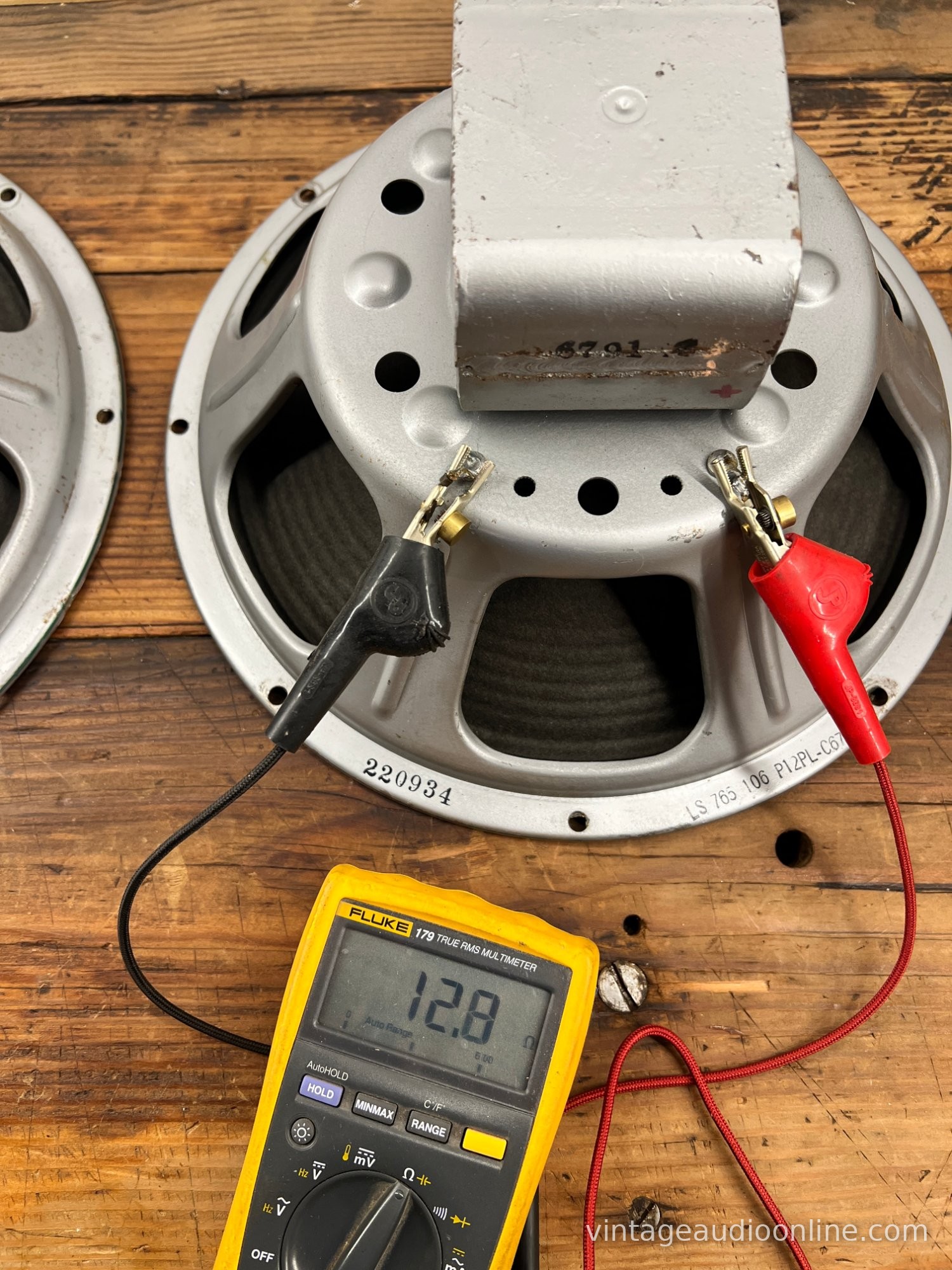
Many American drivers carry an EIA source-date code. The first three digits identify the maker: 220 is Jensen, 328 is Utah, 391 is Altec and 649 is Electro-Voice. On many 1960s drivers the next digit is the last digit of the year and the final two are the week, so you have to work out the decade from other clues. Later codes use two digits for the year.
The grey 12-inch driver below is stamped 220934: Jensen, week 34 of a year ending in 9. The stamp alone doesn't say which decade, so look at the design and the other parts in the same set.
What about field-coil speakers?
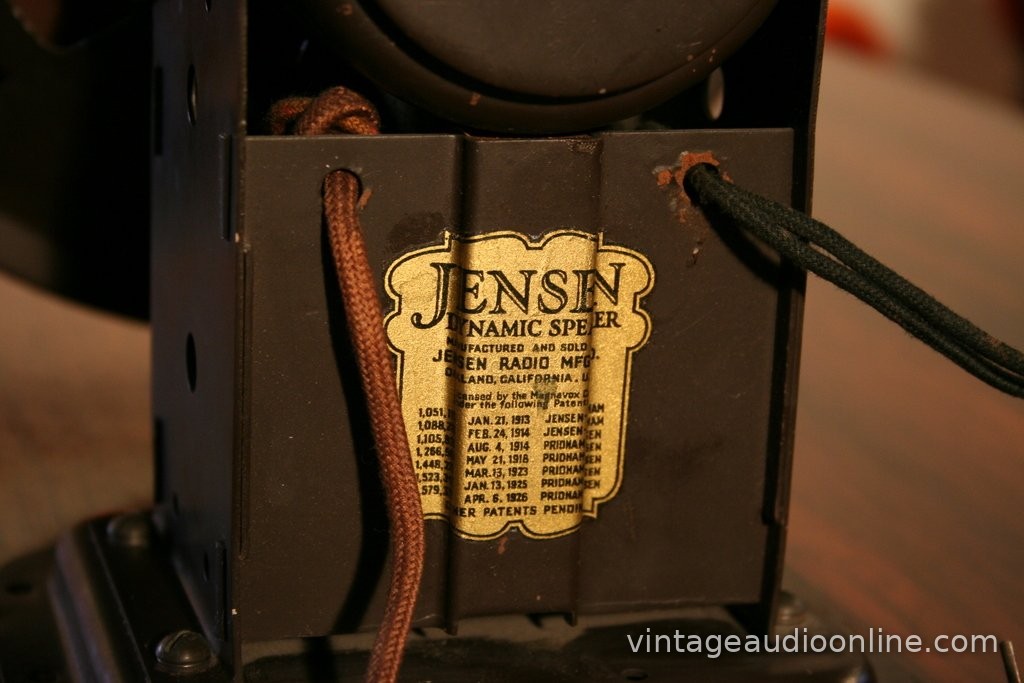
Very early radio and console speakers often used an electromagnet, called a field coil, instead of a permanent magnet, powered by the radio's own supply. These have two windings to check: the voice coil, which reads a few ohms like any speaker, and the field coil, which reads much higher. The radio's schematic or service notes give the expected field-coil value. Because the field coil is part of the power supply, it carries high voltage when the set is on. Test it only with the set unplugged.
FAQ
Why does my 8-ohm speaker read 6 ohms? That's normal. The meter reads DC resistance, which sits below the rated impedance.
Can I test a speaker without taking it out of the cabinet? You can check the wiring at the input terminals, but you'll be reading through the crossover. To judge one driver, disconnect at least one of its leads.
Will a multimeter damage my speaker? No. A meter's test current is tiny. Just never measure while an amp is connected and on.
Tools that make this easier
As an Amazon Associate I earn from qualifying purchases.
I've used each of these tool types on the bench. The links go to Amazon searches, so pick the specific product that suits you.
- Digital multimeter: any decent digital meter does this job. Look for a low resistance range, a clear display and a continuity beeper, which is handy for chasing broken leads.
- Alligator clip test leads: clips hold steady on small speaker terminals, so the reading doesn't flicker and you can press the cone while you watch the number.
- Small flashlight or inspection light: most cone, spider and dust-cap damage is easier to spot with a bright light raking across the surface.
Looking for vintage drivers or speakers?
When you shop for drivers, ask the seller for a DC resistance reading on each one and a photo of the frame stamp. A seller who has done the test is usually a seller who has looked closely. These links open eBay search results, not specific listings:
Paid links
- Search eBay for JBL 075 tweeters
- Search eBay for vintage 12-inch alnico speakers
- Search eBay for vintage Jensen speakers
If you're restoring a full speaker system, the original literature can list driver part numbers and crossover values. Our store's service manuals collection is one place to start looking.